The Capital Stack: How Companies Structure Debt & Equity to Fund Growth
| September 9, 2026Why the Capital Stack Matters in Corporate Finance
If a company wants to expand, it needs funding. Companies must decide how to raise these funds, called capital. With adequate capital, companies can invest in growth opportunities like launching a new product, acquiring another business, or scaling operations.
That’s where the capital stack comes in. Understanding the capital stack will help you analyze how companies secure funding, manage financial risk, and make investment decisions.
This guide breaks down what the capital stack is, its components, and how companies structure their financing to optimize growth.
Key Highlights
- The capital stack refers to the structured hierarchy of financing sources used to fund a company’s assets, operations, and growth.
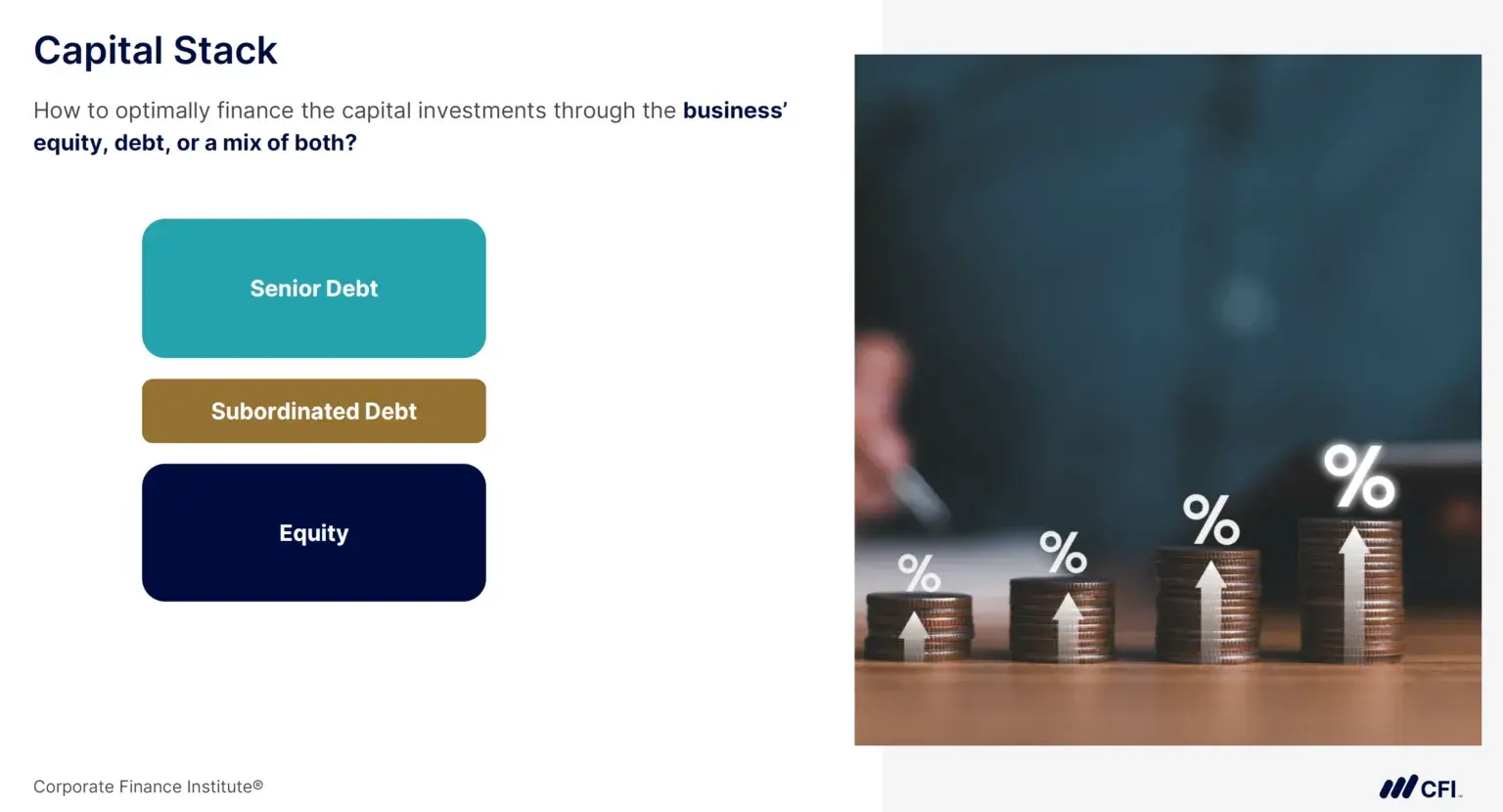
- The three general layers of the capital stack are senior debt, subordinated debt, and equity
- A well-structured capital stack optimizes risk and return, allowing businesses to expand sustainably while managing financial obligations.
What is the Capital Stack? A Hierarchy of Financing Layers
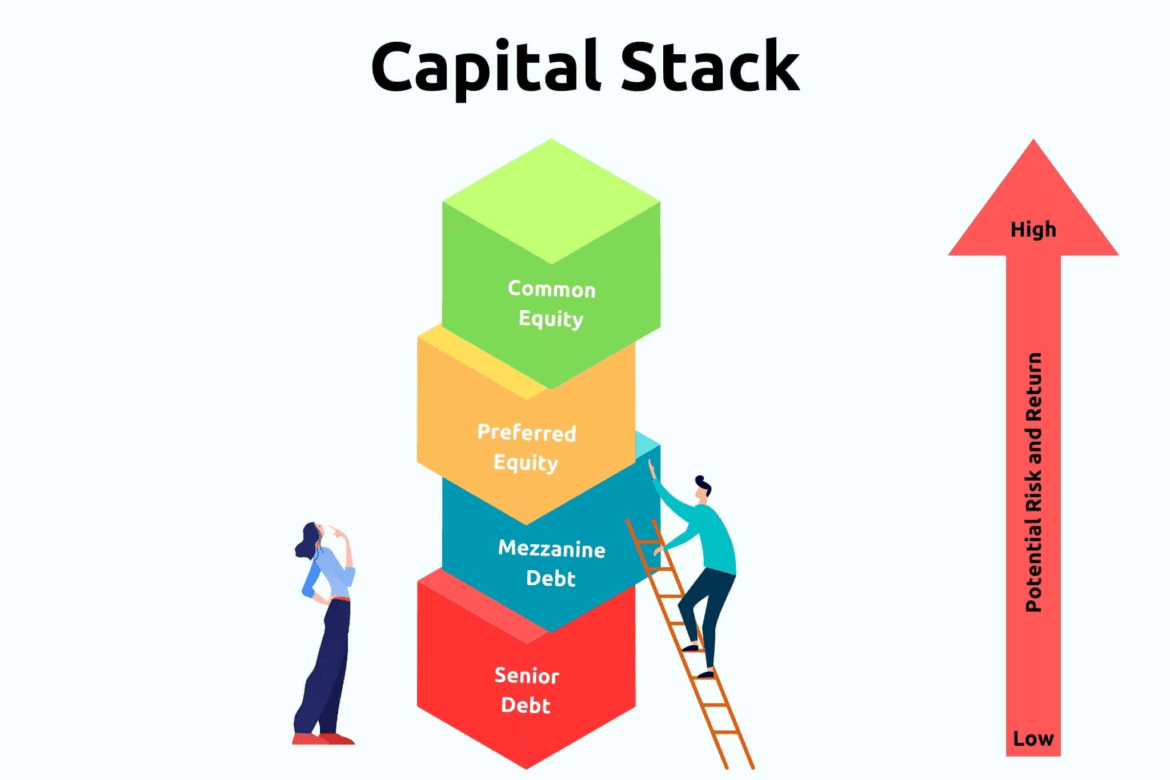
The capital stack refers to the structured hierarchy of financing sources used to fund a company’s assets, operations, and growth. It categorizes different types of capital based on risk and return expectations and repayment priority in case of liquidation or financial distress.
In corporate finance, the capital stack is typically divided into three main layers:
-
- Senior debt – The lowest-risk financing, secured by company assets and repaid first in the event of liquidation.
- Subordinated debt – Higher-risk debt that ranks below senior debt in repayment priority but offers higher interest rates to compensate lenders.
- Equity – Represents ownership in the company, carries the highest risk, and is repaid last but provides the greatest potential for long-term returns.
The composition of a company’s capital stack influences its cost of capital, financial stability, and investment attractiveness, as each layer has a different risk-return profile.
Optimizing the capital stack allows companies to balance financial risk while maintaining flexibility for strategic growth and funding decisions.
Debt in the Capital Stack: Raising Capital Efficiently
Debt allows businesses to raise capital without giving up ownership. Companies often prefer debt over equity for the following reasons:
-
- It’s cheaper than equity – Interest payments on debt are tax-deductible, while dividends paid to equity holders are not.
- Debt increases return on equity (ROE) while preserving ownership, as companies raise funds without diluting shares.
- It amplifies private equity investments – Private equity firms rely on debt to maximize investment returns from leveraged buyouts (LBOs).
Example: Tech startups often raise capital through equity financing because they lack steady cash flow to repay debt. In contrast, established companies like Walmart or Apple use debt strategically because they generate consistent revenue.
However, too much debt increases financial risk. If a company cannot generate enough cash flow to meet debt obligations, it may face credit downgrades or bankruptcy.
Senior Debt: The Foundation of the Capital Stack
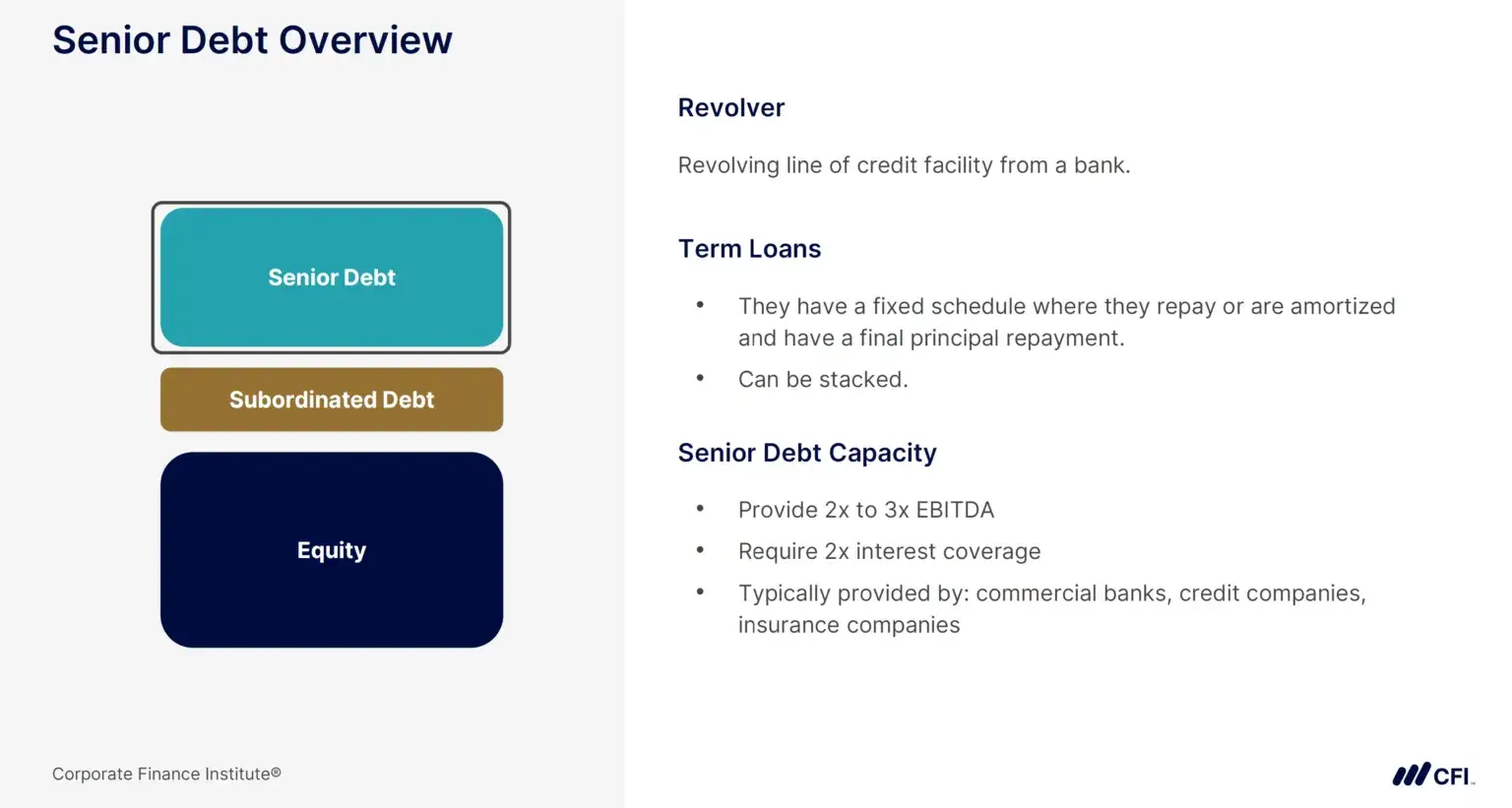
Senior debt is considered the safest and most secure form of capital. It is typically backed by company assets and must be repaid before all other financing.
Common types of senior debt include:
-
- Revolving credit lines – Short-term financing often used for working capital.
- Term loans – Fixed repayment schedules with relatively low interest rates.
Companies use senior debt because it has the lowest borrowing costs, but lenders impose strict repayment terms and may require financial covenants to protect their investment.
Subordinated Debt: Higher Risk, Higher Return
Subordinated debt sits below senior debt in the capital stack, meaning it carries higher risk but also higher interest rates.
Types of subordinated debt include:
-
- Mezzanine debt — Hybrid financing that combines debt with equity-like features.
- High-yield bonds (“junk bonds”) — Unsecured debt with high interest rates.
- Payment-in-kind (PIK) loans — Deferred interest payments that are added to the loan balance.
Companies turn to subordinated debt when they have maxed out senior debt capacity but still need additional funding.
Equity in the Capital Stack: Understanding Ownership Financing
Equity is the bottom layer of the capital stack and represents ownership in a company. Unlike debt, which requires repayment with interest, equity investors take on risk in exchange for a share of future profits.
Equity is often used by companies that:
-
- Are in early growth stages and cannot take on debt.
- Want to raise capital without immediate repayment obligations.
- Prefer to avoid the restrictions lenders place on borrowing.
Unlike debt financing, which has fixed repayment schedules, equity investors are only repaid if the company succeeds. This makes equity a higher-risk, higher-reward form of financing.
There are two main types of equity: common equity and preferred equity.
|
|
Where Do Companies Get Equity Financing?
Companies raise equity capital from private and public markets:
-
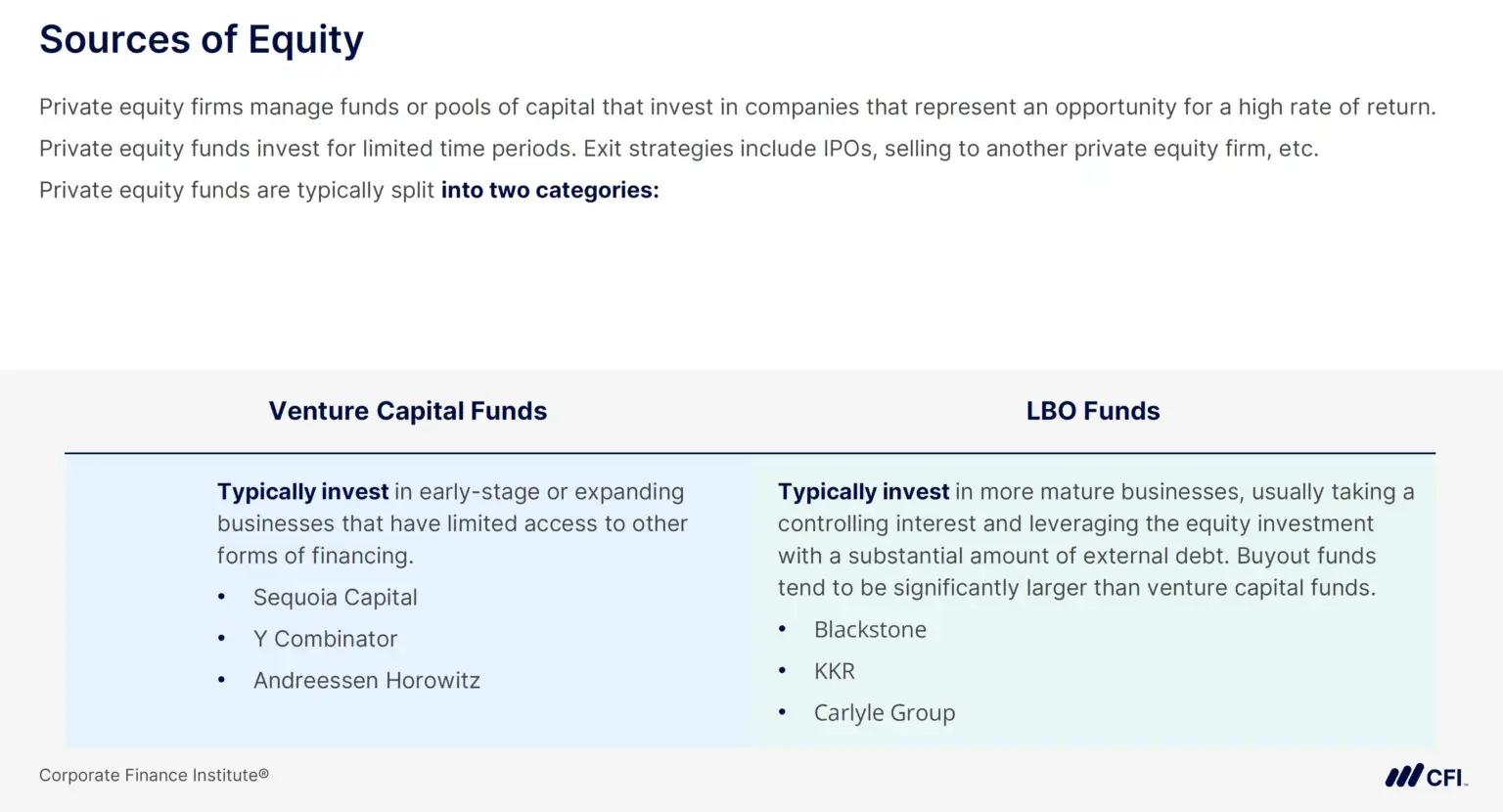
- Private Markets: Early-stage funding from founders, angel investors, venture capital (VC) firms, and private equity (PE) investors.
- Public Markets: Includes initial public offerings (IPOs) and secondary markets (think of stock exchanges).
Companies often balance equity with debt financing to raise capital while maintaining control and avoiding share dilution. Share dilution occurs when a company issues more shares, which means existing shareholders own a smaller percentage of the company.
Debt & Equity Tradeoffs: Finding the Optimal Capital Structure
Companies must balance debt and equity to create an optimal capital structure — the right mix of financing that minimizes risk and cost of capital while maximizing value.
| Debt |
|
|
| Equity |
|
|
Key Takeaway: A well-structured capital stack helps companies maintain financial flexibility while maximizing investor returns.
Take Your Capital Stack Expertise to the Next Level
The capital stack is the structured hierarchy of debt and equity financing that companies use to fund growth. Each layer — senior debt, subordinated debt, and equity — carries a different risk, return potential, and repayment priority. A well-balanced mix of debt and equity optimizes capital costs, preserves financial flexibility, and maximizes shareholder value.